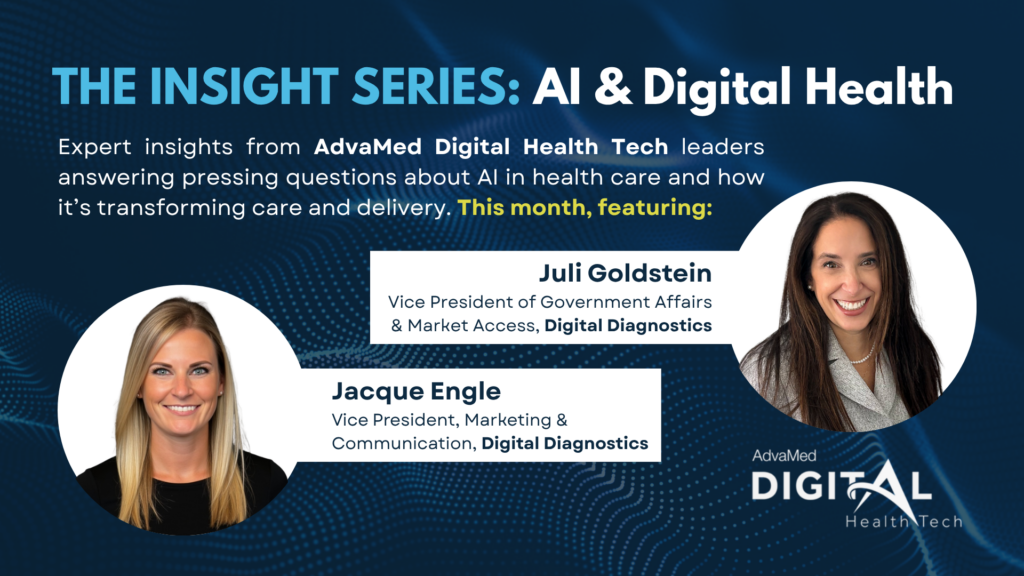
AdvaMed’s Digital Health Tech division brings together leading companies developing AI-enabled solutions that are transforming health care, from diagnosis and treatment to clinical decision support and care beyond traditional settings.
“The Insight Series: AI & Digital Health” features industry experts answering key questions to help inform policymakers and the public about how AI is shaping the future of care delivery. Our latest edition features Jacque Engle, Vice President of Marketing & Communication and Juli Goldstein, Vice President of Government Affairs & Market Access at Digital Diagnostics.
AdvaMed: How is artificial intelligence changing health care today, and what should patients know about it?
Jacque Engle: AI is no longer a future promise in health care. It is here and already changing lives. Digital Diagnostics™ is the clearest example of that reality. LumineticsCore® is the first fully autonomous AI diagnostic system cleared by the FDA-in any specialty of medicine. The system is designed to detect diabetic retinopathy, a common complication of diabetes and a leading cause of blindness.
What makes this meaningful for patients is where and how it works. LumineticsCore brings high-quality diagnostic services to the point-of-care thereby meeting patients where they receive care, bridging the gap between specialty and primary care and delivering accessibility, affordability, and access to necessary care. A patient with diabetes can now walk into a primary care or family medicine visit and receive a retinal diagnosis for diabetic retinopathy on the spot, with no specialist appointment needed and no long wait. Perhaps even more impactful, a finding of diabetic retinal disease it more than just a complication from diabetes; it is an early warning sign of impending risk for stroke, kidney failure, and peripheral vascular disease. Detecting diabetic retinal disease in the frontline settings of care, health care providers can make therapeutic changes that prevent acute complications from diabetes. As a whole, that is a fundamental shift in how care is delivered.
Patients should know that FDA authorized AI tools used in their care have gone through rigorous clinical validation and regulatory review. LumineticsCore is not a prototype or a research experiment. It received FDA clearance in 2018 and was one of the first systems to receive breakthrough device designation following the signing of the 21st Century Cures Act, marking a milestone in the integration of AI into medicine as a whole.
AdvaMed: What are the biggest benefits AI brings to patient care today — and what’s just hype?
Juli Goldstein: The real benefits are tangible and measurable. In our pivotal clinical trial, LumineticsCore avoided 91% of unnecessary specialty visits by providing a diagnostic result at the point-of-care showing patients as negative for more than mild diabetic retinopathy. That means fewer burdensome referrals, faster answers related to possible health complications, and a more efficient use of the health care system for patients who do not need specialist follow-up.
The access dimension is equally real. Every year, over 60,000 people go blind from diabetic retinopathy, a condition that is almost entirely preventable if caught early. Yet as few as 15% of people living with diabetes receive the annual eye exam they need. AI can close that gap at scale in a way that simply adding more specialists cannot.
What is hype? The idea that AI can broadly transform care without the hard work of clinical validation, regulatory clearance, workflow integration, and reimbursement infrastructure. Sustainable reimbursement is key to scaling adoption and thereby realizing the potential benefits of medical AI to better health outcomes for all. At Digital Diagnostics, we have pursued all of those pieces deliberately, including achieving industry firsts such as the autonomous AI CPT® code in the medical section of the CPT editorial code book (CPT Code 92229) and attainment for related quality measures that can make reimbursement possible and the technology self-sustaining in clinical practice.
AdvaMed: Should patients be worried that AI tools used in their care are replacing their clinicians?
Jacque Engle: No, not when there is FDA clearance and oversight, and LumineticsCore is a good illustration of why. Clearance under the FDA requires rigorous safety validation and requires ongoing monitoring, oversight, and extensive documentation. The AI-driven system performs the interpretation and delivers a diagnostic report at the point-of-care without the requirement for a remote specialist overread, but that is not the same as replacing the clinician relationship. The clinician still needs to order the exam, educate the patient on the findings from the exam, and use their clinical acumen to make treatment plans and referrals for follow up. It means that a specific, well-defined interpretation task can be performed reliably at the point of care, thereby strengthening the patient – clinician relationship.
LumineticsCore enhances the clinical team. This AI technology has improved satisfaction for both patients and the clinical team by providing clinicians with real-time data to manage diabetes care and patient relationships more effectively. When a patient tests positive for diabetic retinopathy, that result immediately prompts a timely, actionable referral to a specialist, reducing time-to-follow-up from 60 days with a remote reading network to just 5 days with LumineticsCore. Moreover, since a finding of diabetic retinal disease can be a signal of impending risk of cardiovascular and other complications, there have been significant anecdotal stories from providers who have used the results to improve diabetes management together with patients.
AI tools also carry an ethical obligation to work without bias. LumineticsCore has been trained and validated to mitigate bias and ensure the system works equally well for all people, regardless of sex, race, or ethnicity. That commitment to fairness is part of what makes responsible AI a complement to, not a replacement for, human-centered care.
AdvaMed: What does the future of AI look like in health care?
Juli Goldstein: We are at the beginning of a significant expansion. Ophthalmology led the way, and the lessons learned with LumineticsCore are now paving a path for AI diagnostics across many more conditions. AI will move beyond diabetic retinopathy to layering on more diagnoses, with algorithms likely to help diagnose age-related macular degeneration and glaucoma, and a single AI-enabled platform with the capability to potentially diagnose all of these conditions through eye imaging, which holds promise for non-invasive imaging and lowering cost of care.
More broadly, the future will see autonomous AI move into areas of medicine where access gaps are most severe, including chronic disease management, rural communities, and resource-limited settings globally. Autonomous AI increases health care system productivity, which could increase care access and reduce health disparities.
The regulatory and reimbursement infrastructure built around LumineticsCore, the first FDA-cleared device to autonomously diagnose anything in any field of medicine, has created a roadmap others can follow. That infrastructure is as important as the technology itself. As Dr. Michael Abramoff, founder of Digital Diagnostics, has noted: “You cannot buy a fully autonomous, self-driving car that is street-legal, but you can get diagnosed by a ‘street-legal,’ FDA-cleared, bioethically sound, reimbursable autonomous AI.” That is the future we are building toward, together with regulators, providers, payers, health systems, medical associations, and patients.
AdvaMed: If you could change one thing about how we adopt and utilize AI in health care, what would it be — and why?
Jacque Engle: We would accelerate the alignment between innovation, reimbursement, and health care access together, not sequentially.
Too often, a promising AI tool clears the FDA, then sits on the shelf while the reimbursement and coverage debates play out over years. During that time, patients, especially those in rural and vulnerable communities who stand to benefit most, go without. As adoption lags in spite of regulatory approval, the decisions about which operational, reimbursement, and trust-building barriers to prioritize may shape not only a single product’s future but the broader path of AI in medicine.
At Digital Diagnostics, we believe AI developers, policymakers, payers, health systems, associations, and clinicians need to build those pathways in parallel, not in sequence. The potential is too urgent. Digital Diagnostics is paving the way for rigorously validated autonomous and bias-free AI technology to become a new standard of care, contributing to democratizing health care and closing care gaps. But realizing that vision requires policy frameworks that move at the pace of the need, not just the pace of the technology.
AdvaMed: When the Social Security Act was written in 1965 no one could have imagined that a simple eye scan could one day detect the most costly and chronic conditions before symptoms even appear. How do we modernize Medicare and the broader regulatory environment to keep pace with innovations like cutting-edge diagnostics?
Juli Goldstein: LumineticsCore has proven that autonomous AI can deliver a reliable, accessible, FDA-cleared diagnosis at the point-of-care. That was the foundation. What we are building toward now is a platform approach rooted in systemic disease detected using non-invasive, lower cost ocular imaging, connecting patients and providers through a single, seamless delivery platform.
For patients, this means a routine, non-invasive eye exam could one day serve as an early warning system for some of the most serious and costly diseases we face. For providers, it means a connected platform that surfaces actionable insights at the point-of-care, closes referral loops, and makes proactive chronic condition management possible at scale across front-line care settings, specialty care, and vulnerable communities alike.
The accessibility and non-invasive nature of ocular imaging positions early disease detection as particularly valuable for testing programs in resource-limited settings, with the potential to expand disease assessment to general health testing programs outside of traditional clinical practice. That aligns directly with our mission: healthcare for all, not just those with ready access to specialists.
We started with diabetic retinopathy because the need was urgent and the evidence of the gap in care was clear. The platform we are building will carry that same rigor, the same commitment to bias-free validation, and the same focus on real-world deployment, into a much broader vision of what AI-powered diagnostics can do for people everywhere.
The law governing Medicare was written in the era of 8-tracks – before the Sony Walkman, before the internet, and long before anyone imagined that an eye scan could spot early signs of chronic, debilitating, costly disease. Medicare and most of insurances’ coverage rules were built for a different world. So how can we move beyond the 1965 legislation into the 21st Century to keep pace with innovations such as AI in ocular imaging to truly achieve improvements in healthcare and bend the cost curve?
Hear Patient Stories
The Story of Medtech empowers patients to share their experiences with medical technology in an effort to educate, inspire, and create community.