AdvaMed’s Digital Health Tech division brings together leading companies developing AI-enabled solutions that are transforming health care, from diagnosis and treatment to clinical decision support and care beyond traditional settings.
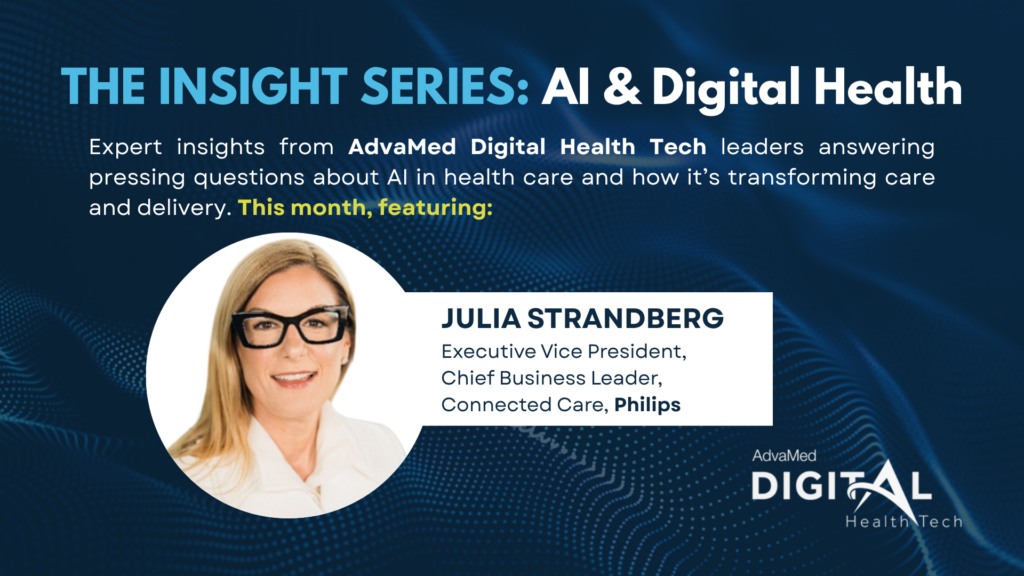
“The Insight Series: AI & Digital Health” features industry experts answering key questions to help inform policymakers and the public about how AI is shaping the future of care delivery. Our latest edition features Julia Strandberg, Executive Vice President, Chief Business Leader, Connected Care at Philips.
AdvaMed: How is artificial intelligence changing health care today, and what should patients know about it?
Julia: Artificial intelligence is already shaping health care in very practical ways, especially behind the scenes. It’s helping clinicians interpret data faster, prioritize patients who need attention sooner, and focus on what matters most by reducing noise and administrative burden that can take time away from care.
At Philips, this comes to life through a connected approach. Our AI innovation connects real-time and longitudinal patient data across the entire health continuum – from acute hospital settings to ambulatory care and the home – transforming complexity into clear, predictive, and actionable insight. By embedding AI into the workflows clinicians already rely on, we’re making care more proactive and coordinated.
What patients should know is that AI is not operating in isolation. It’s supporting clinicians with better information, earlier. That can mean faster diagnoses, more personalized care, and ultimately better outcomes.
AdvaMed: What are the biggest benefits AI brings to patient care today — and what’s just hype?
Julia: The real value of AI today comes down to improving clinical decision-making, increasing operational efficiency, and helping health care systems manage growing demand with limited resources.
Where it’s working well is in areas like early detection, workflow optimization, and reducing cognitive burden through smarter data interpretation. These are tangible improvements that clinicians are experiencing right now.
What’s often overstated is the idea of AI as a standalone solution. AI on its own doesn’t transform care. Its impact is dependent on trusted, high-quality data at the source that seamlessly integrates into clinical workflows to drive action in real time. Because ultimately, it’s when AI is embedded into workflows and connected across systems that you move from data to meaningful action.
AdvaMed: Should patients be worried that AI tools used in their care are replacing their clinicians?
Julia: No, and that’s an important distinction to make.
AI isn’t about replacing clinical judgment; it’s about elevating it. Health care is fundamentally human, it requires judgment, empathy, and accountability. AI can surface insights or highlight risks, but it’s the clinician who interprets that information in the context of the patient.
When implemented well, AI actually strengthens the patient-clinician relationship by giving clinicians more time to focus on care rather than administrative tasks. It’s about augmenting human expertise, not removing it.
AdvaMed: What does the future of AI look like in health care?
Julia: The future is about more connected, predictive, and personalized care.
When we responsibly connect data across imaging, monitoring, informatics, and virtual care, we unlock insights that support clinicians throughout the entire patient journey – not just at the bedside, but across the enterprise and into the home. That’s what enables earlier intervention and more proactive care.
Over time, AI will become more embedded and less visible. It won’t feel like a separate technology, it will simply be part of how care is delivered, supporting better coordination and decision-making at every step.
AdvaMed: If you could change one thing about how we adopt and utilize AI in health care, what would it be — and why?
Julia: The biggest shift I’d advocate for is moving from fragmented, point solutions to integrated, system-level approaches.
Health care doesn’t operate in silos, and neither should AI. But more importantly, we need to fix the data foundation first. You can’t build intelligence on a shaky foundation. AI is only as good as the data behind it, and if that data is noisy, inconsistent, or not trusted, the AI won’t be either.
Right now, there’s too much focus on building algorithms in isolation and then trying to fit them into clinical environments. We need to flip the script. Start with workflow, how care actually happens in real time, and build AI into those moments so it supports decisions, not disrupts them.
That’s how we move toward a connected ecosystem where data, devices, and workflows are aligned. It’s also how we give time back to care teams, improve operational resilience, and drive better outcomes when and where it matters most. This will require deep collaboration across providers, policymakers, and technology partners, with a shared focus on interoperability, trust, and scalability.
AdvaMed: Any other question(s) you’d like to ask/answer?
Julia: One question I often reflect on is: how do we ensure AI is implemented responsibly and equitably?
As we advance these technologies, we have a responsibility to ensure they improve access to care, not widen gaps. That means designing solutions that are inclusive, validating them rigorously, and working closely with clinicians to ensure they’re used appropriately. Trust is foundational to this. It comes from reliable, high-fidelity data at the source, combined with rigorous validation and seamless integration into clinical workflows.
AI is not optional anymore, but how we implement it will define its impact. If we stay focused on patient outcomes, clinical integration, and responsible innovation, we can ensure it delivers on its full potential.
Hear Patient Stories
The Story of Medtech empowers patients to share their experiences with medical technology in an effort to educate, inspire, and create community.