The United States faces a maternal health crisis demanding urgent action. The U.S. has the worst maternal outcomes among high‑income nations. Our maternal mortality rates far exceed peer countries’, despite the highest per‑capita health care spending. Protecting mothers and improving birth outcomes provides an important opportunity for bipartisan priority leadership.
The Silenced Suffering
While mortality rightly captures headlines, maternal injury is a silent, overlooked driver of human and economic cost. Obstetrical pelvic floor injuries occur in an estimated 10 percent to 15 percent of vaginal deliveries, leaving many women with lifelong complications including incontinence, prolapse, pain, and disability.
Nearly 300,000 women undergo pelvic floor–related surgeries annually in the U.S., representing a profound form of silenced suffering that is under‑addressed, costing the U.S. health care system $1.5 billion to $4.7 billion per year, with average per‑procedure costs approaching $9,000 to $12,000, much of which is borne by American taxpayers.
A Sensible Solution
Despite the scale of the problem, there has been virtually no innovation designed to reduce maternal injuries at the time of childbirth. Materna Medical, Inc. represents a first‑of‑its‑kind effort to harness technology to reduce costly and traumatic post‑partum surgeries by reducing pelvic floor muscle injury during labor. This is precisely the type of outcome‑driven innovation policymakers should want to accelerate.
Medicare has already demonstrated leadership by establishing a new procedure code for Materna Medical’s Ellora™ Obstetrical System. Most Medicare beneficiaries are age 65 or older, but younger individuals who receive Social Security benefits also qualify. These individuals may have disabilities such as end-stage renal disease or amyotrophic lateral sclerosis, and their labor and delivery services are covered by Medicare.
That’s whyMedicare recognition of a maternal health solution is not only an important win for Medicare, but also for private payers and Medicaid programs that follow Medicare’s lead. This step signals that maternal health innovation can be recognized within existing payment infrastructure.
Significant Barriers Remain
However, significant barriers remain. Within FDA’s Breakthrough Devices Program, maternal and obstetrics health technologies face disproportionate hurdles. Such devices have received roughly 0.4 percent of all breakthrough device designations, just five out of more than 1,200, reflecting a lack of recognition of maternal health as an area of serious unmet need.
Current Medicare Diagnosis‑Related Group payment levels for labor and delivery discourage innovation, leaving hospitals unable to absorb the cost of new technologies, even when they reduce long-term maternal harm. This misalignment perpetuates a system where outcomes fail to improve, and avoidable surgeries continue to cost billions of dollars annually.
Targeted policy solutions exist. Inpatient new technology add-on payment eligibility through Medicare and TRICARE for technologies such as the Ellora Obstetrical System would provide a low‑cost, high‑impact bridge to technology adoption. Medicare represents only approximately 2 percent of U.S. births, meaning even full utilization would amount to an estimated $170 million annually in Medicare spending. This modest investment would establish the pathway for broader commercial and Medicaid coverage.
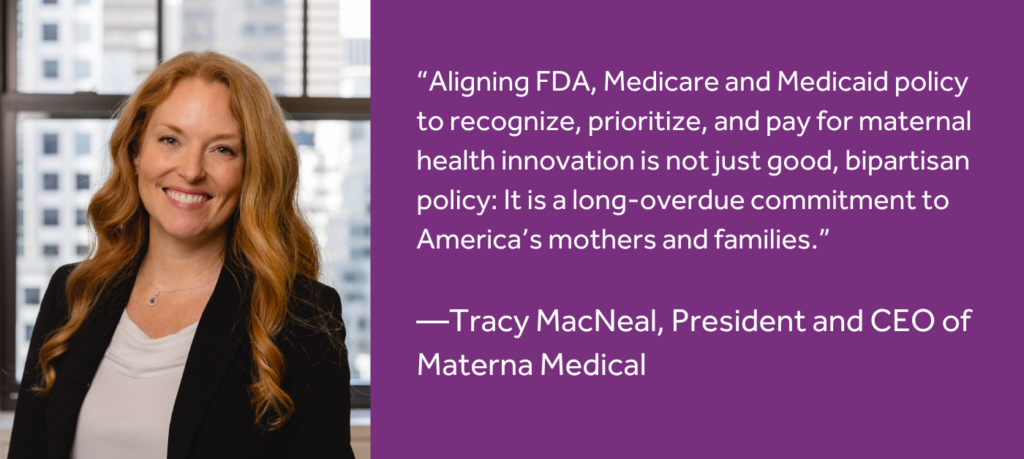
Aligning FDA, Medicare and Medicaid policy to recognize, prioritize, and pay for maternal health innovation is not just good, bipartisan policy: It is a long‑overdue commitment to America’s mothers and families.
Tracy MacNeal is president and CEO of Materna Medical, Inc., which creates innovative solutions for women’s pelvic health.