AdvaMed’s Digital Health Tech division brings together leading companies developing AI-enabled solutions that are transforming health care, from diagnosis and treatment to clinical decision support and care beyond traditional settings.
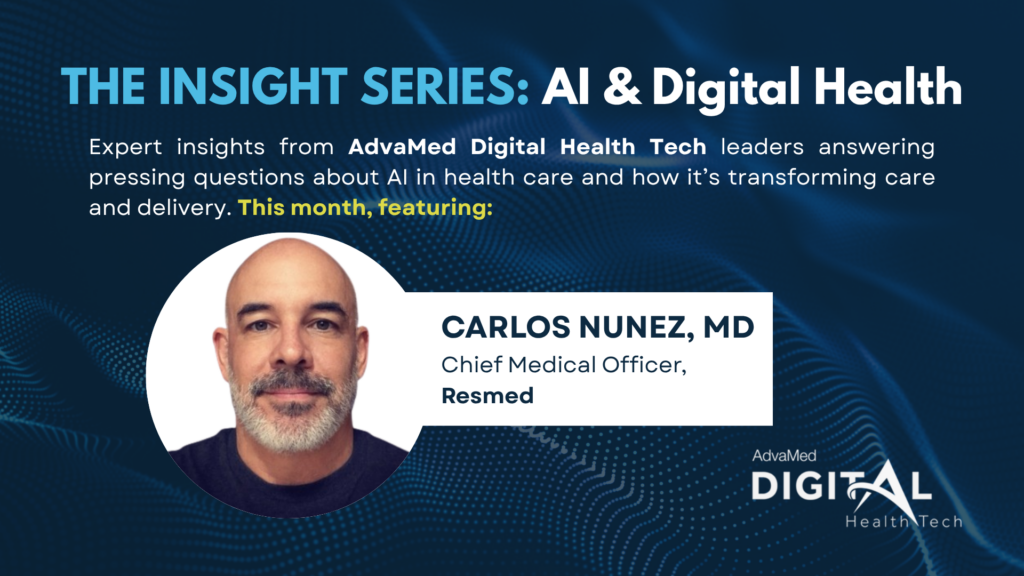
“The Insight Series: AI & Digital Health” features industry experts answering key questions to help inform policymakers and the public about how AI is shaping the future of care delivery. Our latest edition features Carlos Nunez, Chief Medical Officer at Resmed.
AdvaMed: How is artificial intelligence changing health care today, and what should patients know about it? Please feel free to use an example from your company.
Carlos: Across healthcare, artificial intelligence is helping shift care from reactive to more predictive, proactive, and personalized – with significant potential to drive cost savings. While AI can help patients better understand their health, it does not replace a clinician. When used appropriately, it enables faster decision-making by physicians, supports more timely care delivery, and strengthens the patient-provider relationship by surfacing insights earlier and enabling more informed conversations.
At Resmed, we leverage AI to translate complex health data into practical insights for both patients and providers. For example, myAir, Resmed’s consumer app, offers personalized coaching to help patients be more comfortable and stay on CPAP therapy, while our cloud-connected devices allow clinicians to monitor progress and intervene when needed.
We also use AI to help people learn more about sleep disorders. Our generative AI assistant, DAWN, provides patients and consumers with personalized answers to common sleep and therapy questions, helping them feel supported and confident in their care.
AdvaMed: What are the biggest benefits AI brings to patient care today — and what’s just hype?
Carlos: The greatest opportunity for AI today lies in pattern recognition – powering predictive modeling, workflow efficiency, and personalization at scale. AI also has an important role in delivering virtual care efficiently and effectively, enabling patients to receive long-term, personalized support in the comfort of their own homes.
In practice, this means identifying patients at risk of dropping off therapy, enabling earlier intervention, and personalizing treatment to individual needs. Resmed’s Smart Comfort is an FDA-cleared, AI-enabled medical device that recommends personalized comfort settings to help people with obstructive sleep apnea (OSA) start and stay on CPAP therapy. For people new to therapy, this personalization can help improve patient comfort in their therapy experience.
What remains overstated, however, is the idea that AI can or will replace clinical care – it cannot. AI does not operate without a human in the loop; clinicians remain central to decision-making when it comes to patient care. Healthcare is a high-stakes, highly variable environment, and AI requires clinical context and expert governance to be used safely and effectively.
AdvaMed: Should patients be worried that AI tools used in their care are replacing their clinicians?
Carlos: No, and they should expect the opposite. Healthcare is fundamentally a human endeavor. Trust, judgment, and context cannot be automated. AI can support – even enhance – those elements but not replace them.
One of the most effective use cases of AI in healthcare is reducing administrative burden and surfacing insights, so clinicians can spend more time focusing on patients. In many settings, clinicians are managing large volumes of data. AI can help organize that information and highlight what matters most.
At Resmed, our AI tools are designed to support this model. One of our AI models helps home care providers in the U.S. better manage patients at risk of dropping off their resupply schedule or quitting therapy. This enables them to create more personal and timely touch points with patients – helping increase long-term adherence and ultimately drive better patient outcomes, while facilitating care in the home.
AdvaMed: What does the future of AI look like in health care?
Carlos: The future of AI in healthcare is less about breakthrough moments and more about integration.
In the near-term future, I expect we will see AI increasingly embedded into the infrastructure of care. This means connecting data across settings, enabling earlier detection of risk, and supporting more continuous, home-based care models at a much lower cost than hospital settings. This is particularly relevant for chronic conditions, where longitudinal data and day-to-day behaviors matter.
Equally important will be the maturation of governance. As AI systems evolve, we need clear standards for validation, monitoring, and accountability to ensure these tools remain safe, effective, and trustworthy over time. Privacy and data protection are foundational to Resmed’s use of AI, guiding how we collect, manage, and apply insights at scale.
AdvaMed: If you could change one thing about how we adopt and utilize AI in health care, what would it be — and why?
Carlos: I would focus on building consistent, industry-wide frameworks for trust.
AI adoption in healthcare will ultimately depend on trust — trust from clinicians, patients, and regulators that these systems are reliable, validated, and appropriately governed. But this requires clear standards around how models are developed, tested, monitored, and updated over time.
We also need to move beyond isolated use cases and focus on integration. Many of the inefficiencies in healthcare stem from fragmentation — data that does not connect, systems that do not communicate. AI has the potential to help address that, but only if it is implemented as part of a broader, interoperable infrastructure.
If we get those two elements right, we can create the conditions for AI to deliver meaningful, scalable impact across the industry for patients and providers alike.
AdvaMed: Any other question(s) you’d like to ask/answer?
Carlos: One important point is that AI in healthcare is not new.
Many forms of machine learning and data-driven modeling have been embedded in medical technology for years. What is changing now is accessibility — more data, more computing power, and more connectivity across care settings.
Equally important is how we handle data. Privacy and data protection must be foundational to how AI is developed and applied. The focus should remain on responsible, evidence-based use of AI to support patients and providers. When grounded in safety, transparency, and clinical oversight, AI can help improve access, outcomes, and the overall experience of care.
Hear Patient Stories
The Story of Medtech empowers patients to share their experiences with medical technology in an effort to educate, inspire, and create community.