
Supporting Small Medtech Innovators (SBIR)
AdvaMed supports the competitive federal grant programs integral to next-generation medtech solutions for patients.
SBIR Overview
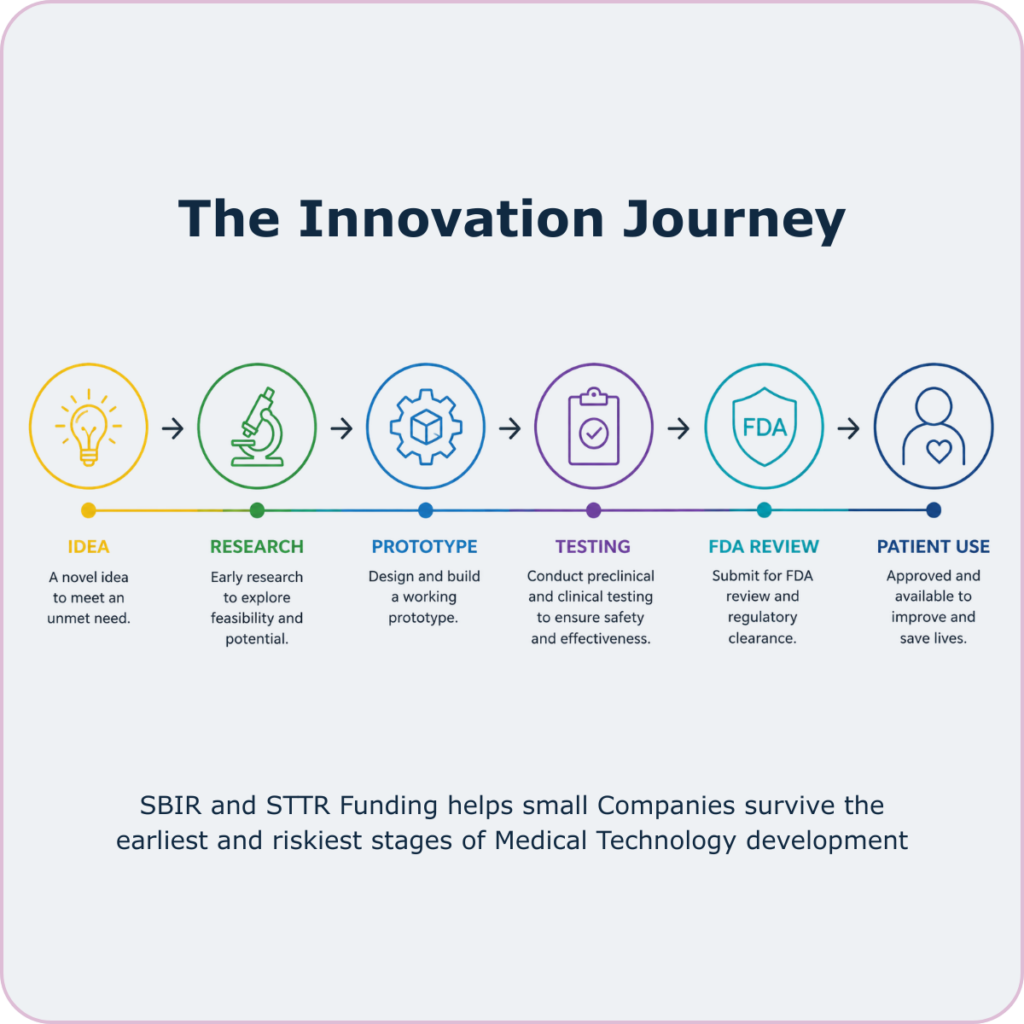
The federal Small Business Innovation Research (SBIR) and Small Business Technology Transfer (STTR) grant programs offer critical early-stage funding to small medtech businesses and startups. The highly competitive programs support the extensive research and development necessary to help entrepreneurs transform their ideas from concept to reality.
Most medtech companies, including AdvaMed members, are small businesses and startups. These entities often evolve from a clinician or engineer with a novel idea to serve patients with unmet needs.
Without the work of these entrepreneurs, medtech innovation would stall. And without federal grant funding, many innovations would fail Years of extensive research and development are required to validate and test new products for use in patients, and private risk capital alone cannot sustain high-risk, high-reward medtech ventures. The SBIR/STTR programs are vital to bring the most promising technologies for patients through the early stages of development, clinical testing and regulatory submission.
Why This Matters
These programs have tremendous economic impact. A comprehensive, long-term study, from the National Cancer Institute, found that $787 million in SBIR Phase II awards generated $9.1 billion in total sales of products and services resulting from these grants, as well as $2.9 billion in new tax revenue and nearly 108,000 new jobs in the U.S. Surveyed companies in this cohort of awardees raised $4.26 billion in follow-on investment funding, and of the 101 companies that were acquired for their technologies, the total acquisition value was $21.63 billion.[1]
After a lapse in 2025, Congress reauthorized these programs in April 2026, restoring this critical source of funding for medtech innovation and the next generation of technologies for patients nationwide. The five-year authorization period gives much-needed stability to the product development lifecycle and sustains the U.S. as a global leader in medtech innovation.

[1] https://www.sbir.gov/sites/default/files/documents/NCI_SBIR_ImpactStudy_2pager.pdf

Case Study
U.S. Seed Funding Helps Create “Good Days” for Patients
After a lapse in 2025, Congress reauthorized these programs in April 2026, restoring this critical source of funding for medtech innovation and the next generation of technologies for patients nationwide.

Case Study
Liberate Medical Finds Freedom to Innovate Via Key Federal Grant Program
Liberate Medical used STTR grants to develop a device that prevents muscle atrophy in ventilated patients, aiding recovery.
Frequently Asked Questions
What is the SBIR program and how does it support medtech startups?
The Small Business Innovation Research (SBIR) program provides federal grants to small businesses engaged in research and development with commercialization potential. For medtech startups, SBIR is often the earliest source of non-dilutive capital to fund device development.
What challenges do small medtech companies face in commercializing new devices?
Small companies face a ‘valley of death’ between early-stage funding and commercial launch — characterized by insufficient capital, extensive regulatory approval cycles, and difficulty securing coverage and reimbursement.
Why is SBIR particularly important for small medical device companies?
Medical device development requires costly clinical trials, regulatory submissions, and manufacturing scale-up. SBIR grants provide critical early-stage funding that allows small innovators to reach proof-of-concept, validate and test new products, and attract private follow-on investment.
What is AdvaMed’s position on support for small medtech innovators?
AdvaMed advocates for robust SBIR funding, accessible FDA pathways for small companies, and reimbursement policies that support novel device development, improved patient outcomes, and value to the healthcare system.
What role does the SBIR program play in advancing health equity in medtech?
SBIR supports diverse entrepreneurs and innovations targeting underserved conditions and populations.. This makes SBIR a critical tool for broadening medtech’s societal impact.
What is the ‘valley of death’ in medtech startup commercialization?
The ‘valley of death’ refers to the funding gap between early R&D (supported by SBIR and other grant programs) and commercial launch (supported by venture capital or revenue). Many promising innovations fail at this stage due to insufficient bridge capital.
What federal programs beyond SBIR support small medtech innovators?
Beyond SBIR, small medtech innovators can access STTR (Small Business Technology Transfer) grants, NIH funding, DoD medical research programs, the Congressionally Directed Medical Research Program (CDMRP) and NSF innovation grants — as well as state-level economic development and university commercialization programs.
How can policymakers strengthen the medtech startup ecosystem?
Key policy levers include increased SBIR appropriations, streamlined FDA pathways for novel devices, Medicare coverage policies that shorten the timeframe from regulatory approval to reimbursement for breakthrough technologies,, and support for regional medtech incubators and accelerators.
AdvaMed’s Priority Policies
AdvaMed Supports
Policies that strengthen the SBIR and STTR programs and help small medtech innovators thrive.
- Increase and sustain SBIR/STTR funding opportunities
- Improve transparency and efficiency in the review process
- Make SBIR/STTR programs permanent
- Reduce unnecessary administrative burden
AdvaMed Opposes
Policies that create uncertainty, add barriers, or delay innovation for small companies.
- Interruptions or uncertainty in program funding
- Delays in award decisions and fund distribution
- Administrative or regulatory burdens that slow innovation
- Lapses in reauthorization that disrupt long-term planning
Recommendations
Congress and federal agencies should take the following actions to drive medtech innovation.
- Congress should provide predictable, robust funding.
- Congress should enact permanent authorization.
- Federal agencies should streamline review timelines.
- Policymakers should support policies that reduce burden and promote innovation.