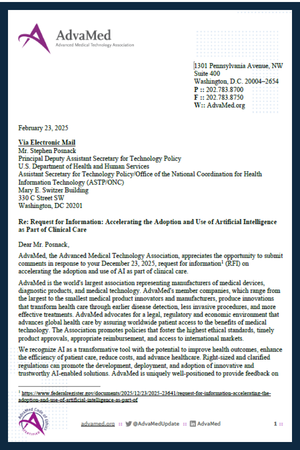
AdvaMed® Comment Letter to ASTP/ONC: Removing Barriers to AI-Enabled Medical Technologies in Clinical Care
In this AdvaMed® Comment Letter to ASTP/ONC,AdvaMed® responds to HHS’s Request for Information on accelerating AI adoption in clinical care. The letter outlines key policy reforms to unlock the full potential of AI-enabled medical devices for patients and clinicians.
AdvaMed’s member companies have developed and deployed AI-enabled medical devices for more than 25 years. As of December 2025, FDA has authorized over 1,300 AI-enabled medical devices. This reflects the medtech industry’s proven track record of bringing safe, effective innovations to patients. However, regulatory, coverage, and data privacy barriers continue to slow adoption and limit patient access.
AdvaMed urges HHS to prioritize reforms in three key areas:
1. FDA Regulation of AI-Enabled Medical Devices First,AdvaMed® recommends improving transparency in the De Novo premarket pathway. In addition,AdvaMed® calls for expanding use of Predetermined Change Control Plans (PCCPs) to keep pace with rapid AI innovation. Finally, FDA guidance should distinguish between complex AI systems and traditional machine learning approaches. This distinction would help avoid unnecessary regulatory burden for established technologies.
2. CMS Coverage and Payment for AI Technologies Outdated Medicare payment frameworks create significant barriers to patient access. Therefore,AdvaMed® calls on CMS to modernize the Hospital Outpatient Prospective Payment System (OPPS) and New Technology APC program for Software as a Medical Device (SaMD). Furthermore, the Transitional Pass-Through Payment criteria should be updated to include AI technologies that do not require direct patient contact. Additionally, payment policies under the Physician Fee Schedule should reflect the unique value and costs of SaMD across diverse care settings.
3. HIPAA Data Privacy Reforms Access to high-quality health data is essential for AI development. As a result,AdvaMed® recommends amending HIPAA’s definition of “health care operations” to explicitly include AI model development. Moreover, Safe Harbor de-identification standards should be made more flexible for AI use cases. HHS should also issue guidance to clarify when generative AI tools may process protected health information (PHI) for treatment, payment, and health care operations purposes.
Beyond these three areas,AdvaMed® stresses the importance of maintaining FDA as the sole federal regulator of AI-enabled medical devices. Similarly, the letter supports consensus-based standards over new third-party evaluation frameworks. Lastly,AdvaMed® urges investment in interoperability to enable richer datasets for AI model training and validation.