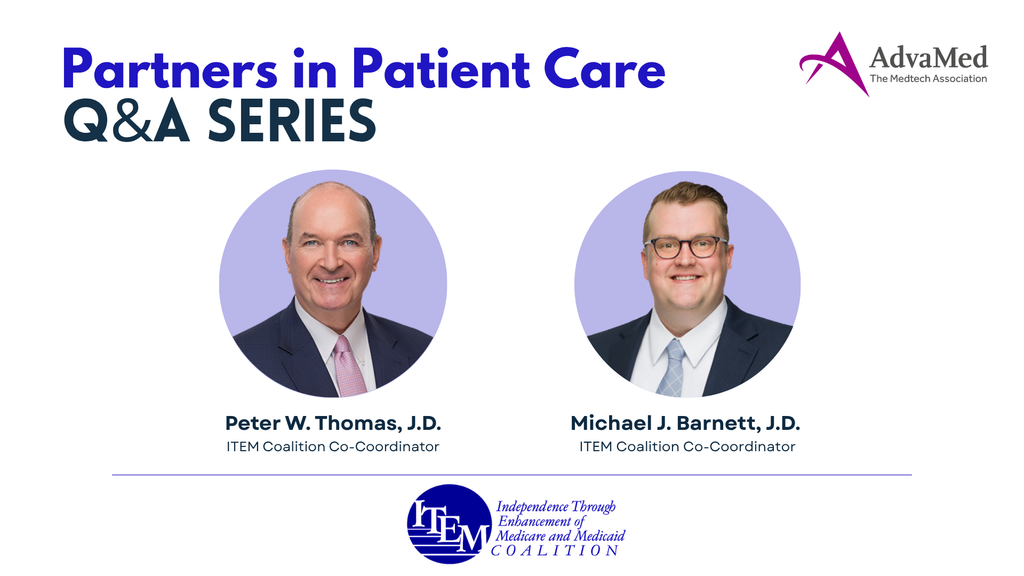
For people living with disabilities and chronic conditions, access to assistive technology can make the difference between dependence and independence. In this installment of AdvaMed’s Partners in Patient Care Q&A series, Peter W. Thomas, J.D., and Michael J. Barnett, J.D., Co-coordinators of the ITEM Coalition, discuss the communities they represent, the barriers patients face, and how collaboration with the medtech community can help improve patient access to assistive technology.
The ITEM Coalition is a national consumer- and clinician-led coalition comprised of 103 national organizations advocating for access to and coverage of assistive devices, technologies, and related services for people of all ages with injuries, illnesses, disabilities, and chronic conditions.
AdvaMed: Who do you represent, how did the organization come to be, and what does your work look like day to day?
Michael Barnett: The Independence Through Enhancement of Medicare and Medicaid (“ITEM”) Coalition is a consumer- and clinician-led coalition comprised of 103 national nonprofit organizations devoted to raising awareness and building support for policies that will enhance access to assistive devices, technologies, and related services for people with disabilities and chronic conditions. Our six-member Steering Committee reflects the breadth of the community we serve, and includes the Amputee Coalition, ALS Association, Christopher & Dana Reeve Foundation, Spina Bifida Association, Team Gleason, and the United Spinal Association.
The ITEM Coalition was created in 2003 to address inadequate access to assistive devices, technologies, and related services. Today, our work focuses on identifying and removing the Medicare, Medicaid, and other federal policy barriers that can prevent people from obtaining the assistive devices and technologies they need to be healthy, functional, and independent.
Day to day, that means working closely with our members to monitor legislation and regulations, engage with Congress and federal agencies, develop coalition comments and recommendations, and advocate on coverage, coding, payment, and other policies affecting access to care. We also bring together diverse patient, disability, clinical, and provider organizations around issues where a unified voice makes a difference.
Ultimately, our strength comes from our members and the lived experiences they bring to the table. Our goal is to ensure those voices are heard when policymakers make decisions that directly affect access to the assistive devices and technologies people depend on.
AdvaMed: What would you most want the medtech community to understand about the patients and families you serve?
Peter Thomas: The patients and families the ITEM Coalition serves are incredibly diverse but share a common need: access to the right assistive technology, equipment, and services at the right time to improve their function and fundamentally change what is possible in their lives. For people living with disabilities or chronic conditions, a wheelchair, prosthetic device, orthotic brace, assistive technology, or other medical device is not simply a product; it can make the difference between dependence or independence, social isolation or community participation, employment or unemployment, and being able to be educated, care for a family, and maximize quality of life.
The ITEM Coalition would also want the medtech community to understand that access does not end when a device becomes available in the marketplace. Patients and families often face complex coverage, coding, payment, and administrative barriers that can prevent them from obtaining assistive technologies their clinicians believe are medically necessary. These barriers can be particularly challenging for people with disabilities and for individuals who rely on Medicare or Medicaid. Our work focuses on ensuring the patient perspective is part of these conversations from the beginning and that innovation ultimately translates into meaningful, timely access for the people these assistive devices and technologies are designed to improve.
AdvaMed: What is your organization’s top policy priority heading into the coming year, and why does it matter to the people you represent?
Michael Barnett: Among the ITEM Coalition’s many priorities heading into 2027, securing Medicare coverage for standing systems in Group 3 power wheelchairs is our top priority. This issue matters because standing systems can provide meaningful health, functional, and independence benefits for people with significant mobility impairments, yet Medicare does not cover these devices despite years of advocacy and clinical evidence. When Medicare coverage does not recognize these needs, beneficiaries can face significant out-of-pocket costs or go without the technology that could meaningfully improve their quality of life.
The ITEM Coalition has been advocating for Medicare coverage of standing systems in Group 3 power wheelchairs for years, including through a pending National Coverage Determination reconsideration request. After six years of waiting for CMS to open a National Coverage Analysis on this issue, we believe it is well past time for CMS to act. This is ultimately about ensuring that Medicare beneficiaries with significant mobility impairments have access to the assistive devices and technologies they need to live more independently and participate fully in their communities.
AdvaMed: What does a strong partnership between a patient organization and the medtech community look like? Are there collaborations that have worked especially well for your community?
AdvaMed: What does a strong partnership between a patient organization and the medtech community look like? Are there collaborations that have worked especially well for your community? Peter Thomas: A strong partnership between a patient/consumer/clinical coalition and the medtech community starts with a shared commitment to putting patients at the center of policy and access decisions. The most effective partnerships are not simply about supporting individual advocacy efforts. Instead, they involve listening to patients and their advocates, understanding the barriers they face, and working together to develop practical solutions that improve access to care and technology.
For the ITEM Coalition, some of our most productive collaborations have involved bringing together patient and disability organizations, clinicians, manufacturers, suppliers, and other stakeholders around a specific access challenge. Each partner brings a different perspective, and that diversity not only adds credibility but also strengthens the advocacy. Medtech companies bring expertise in innovation and the development of new technologies, while patient/consumer organizations help ensure policy discussions remain grounded in the real-world needs of the people who rely on those technologies.
We believe the strongest partnerships are long-term and built on trust, rather than formed only around a particular legislative or regulatory issue.
AdvaMed: Is there anything you’d like to share about your organization or the patient community you serve and advocate for?
Michael Barnett: The medtech community should know that the ITEM Coalition represents the breadth and diversity of the disability, chronic illness, and rehabilitation communities. ITEM brings together more than 100 national non-profit organizations representing these constituencies. While our member organizations have different perspectives and priorities, we share a common goal: ensuring Medicare and Medicaid beneficiaries have access to the medical devices and assistive technologies they need to live healthy, independent, and productive lives.
The ITEM Coalition and its member organizations have a great deal to contribute to conversations about innovation and healthcare access. Patients and people with disabilities understand firsthand what works, what barriers remain, and where innovation is still needed. We see the ITEM Coalition’s role as helping make sure those voices are heard and that innovation translates into meaningful access and better outcomes for the people who need it most.
Get involved: To learn how you can support the ITEM Coalition’s work, contact Michael Barnett at [email protected].
Hear Patient Stories
The Story of Medtech empowers patients to share their experiences with medical technology in an effort to educate, inspire, and create community.