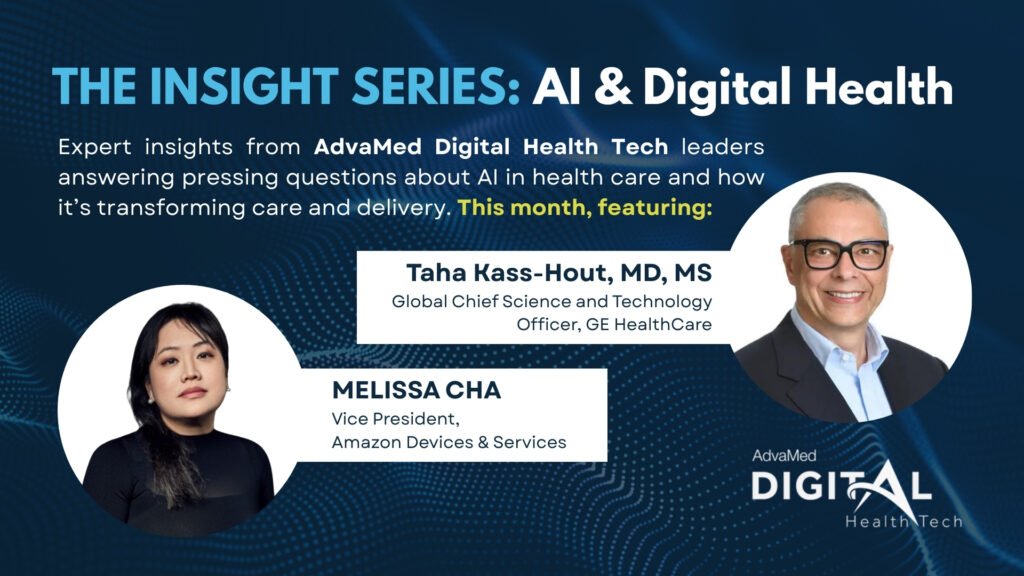
AdvaMed Digital Health Tech division member companies include world leaders in developing AI-enabled solutions to improve health and care, from diagnosis to treatment, clinical decision support, and wearables to wellness. “The Insight Series: AI & Digital Health” will feature company experts, answering pressing questions to inform policymakers and the public about how AI and digital health are transforming care and delivery.
Our inaugural entry is a conversation between Melissa Cha of Amazon and Taha Kass-Hout of GE HealthCare.
Melissa: As we start the new year, I’m delighted to kick off theAdvaMed® Insight Series with my colleague, Taha Kass-Hout, MD.
As Vice President of Health Tech at Amazon Devices & Services, I’m most excited about advances in AI that enable us to build and deliver new solutions across health and wellness. Taha and I first met a decade ago when he was at Amazon Web Services (AWS). He is now the Global Chief Science and Technology Officer at GE HealthCare.
Taha, how is artificial intelligence changing health care today, and what should patients know about it?
Taha: We live in a world where a vast amount of data flows through our health care systems: Today over a third of the world’s digital data is generated by health care. Care providers face significant cognitive overload as they constantly switch between medical images, clinical notes, audio recordings, and device signals. You see this play out during a checkup, when your doctor can often spend more time looking at a screen than sitting down to make a human connection.
That’s where artificial intelligence can make a difference. For care providers, AI opens new possibilities for workflow automation, clinical decision support, and the delivery of more personalized care. For patients, it helps realize the aspiration set forth by Hippocrates all those years ago when he said: “Don’t treat the disease the patient has — instead treat the patient with the disease.”
Over the past decade, advances in machine learning, the rise of foundation models, and the emergence of generative and agentic AI have brought this vision closer to reality. We are now seeing multimodal AI models being adopted across diverse data types, unlocking new opportunities for workflow automation, clinical decision support, and individualized care.
It is important that this future is not one that should unfold only for people living in more affluent countries. There’s an ongoing challenge of access to quality care that continues in many parts of the world: Today, according to the World Health Organization, nearly 4.5 billion[1] people still lack access to essential health services. By making care more efficient, scalable, and precise, AI can help bridge this gap and extend the benefits of modern medicine to more people.
Melissa: In your view, what are the biggest benefits AI brings to patient care today?
Taha: From serving as an interventional cardiologist to my time as the FDA’s first Chief Health Informatics Officer, and now in my current role at GE HealthCare, I’ve learned a simple truth: The most meaningful innovations are rarely flashy. They’re the ones that steadily earn trust, integrate seamlessly, and help clinicians enhance care delivery.
At GE HealthCare, we’re helping bring that future to life in three ways.
First, we’re creating AI-enabled devices designed to improve workflow efficiency and diagnostic confidence. In imaging, for example, deep learning tools help care teams capture clearer images more efficiently and support more consistent diagnostics. Our AIR Recon DL technology can deliver scan times up to 50 percent faster[2], supporting productivity and the patient experience.
Second, we’re embedding AI throughout the care journey — from screening and diagnosis to treatment and monitoring — to enhance efficiency and precision. An example here is CareIntellect for Oncology, which can provide clinicians with progressive summarization to help care teams quickly understand the patient’s care journey.
We’re also exploring the use of generative AI to assist in matching patients with clinical trials by comparing unstructured patient data against complex eligibility criteria, so more people can access appropriate trials.
Finally, we are applying advanced machine learning to help hospitals strengthen operational efficiency. Health care systems are under pressure as admissions rise amid workforce shortages, burnout, and inflation. GE HealthCare’s Command Center helps address these challenges by using predictive analytics to identify bottlenecks and recommend prescriptive actions. By integrating data from electronic medical records, staffing systems, and medical equipment, it provides a unified, real-time view of patient flow, staffing gaps, and resource constraints.
Based on customer-reported outcomes, Deaconess Health System treated approximately 2,000 additional patients annually through improved capacity utilization, while Humber River Hospital reduced average length of stay and gained the equivalent of about 35 new beds without additional infrastructure.[3]
These solutions might not make for headline-grabbing stories, but they help free up a nurse’s time, reduce manual clicks for radiologists, and make workflows more seamless — helping foster trust and human connection.
Melissa: As both a physician and technologist, you bring a unique perspective. Should patients be worried that AI tools used in their care are replacing their clinicians?
Taha: The concern that AI will replace doctors misunderstands both the challenge facing health care and the purpose of these technologies. The problem today is not that we have too many clinicians; we have too few. The health care system is experiencing significant labor shortages, with the World Health Organization projecting a shortfall of 10 million health workers by 2030.
AI enters this picture not as a replacement, but as a tool that extends the reach and impact of every clinician. For example, we announced a research project called Project Health Companion that illustrates how AI could help clinicians manage increasing workloads.
Imagine an AI system functioning as a virtual tumor board with specialized agents co-designed with domain experts. These agents could analyze biochemical, imaging, and pathology data to make recommendations for oncologist review. Rather than replacing medical expertise, this kind of AI could augment it — helping clinicians navigate complexity, focus on judgment, and deliver more personalized care.
By automating routine tasks, synthesizing patient histories, and optimizing schedules, AI could give back something invaluable: time. Time for an oncologist to sit with a patient and discuss difficult news. Time for a scheduler to ensure the right patient receives care at the right moment.
Ultimately, AI aims to support the human connection in medicine — the very reason many of us entered the profession in the first place.
Melissa: You became the FDA’s first Chief Health Informatics Officer. Based on your experience, what does the future of AI look like in health care?
Taha: The future of health care will not unfold through sudden leaps but through steady, deliberate progress that earns trust. I see this evolution across three horizons.
In the short term, the focus is clear: As an industry, we need to scale what works. Most hospitals don’t need more experimentation; they need dependable systems that can move from pilot projects to production. This means building operational intelligence that improves patient flow, optimizes staff schedules, and reduces documentation burden.
In the medium term, health care will shift from diagnosis to intervention. AI is beginning to assist with decision-making, not just detection. Automated breast ultrasound and adaptive radiation therapy are early examples, helping reduce time to treatment and increase precision. Portable, AI-guided devices may support earlier detection and preventive care. Progress will depend on explainable systems that clinicians can trust.
In the long term, health care will evolve toward increasingly automated and assistive intelligence. Machines will act as collaborative tools — imaging systems that optimize protocols, hospital systems that coordinate operations, and connected devices that create digital twins evolving with each patient.
Across every horizon, success will depend on making AI consistently reliable. True transformation comes when technology fades into the background, and clinicians simply trust it. The systems that endure will not be the flashiest, but the ones that make care more efficient, consistent, and human-centered.
Melissa: If you could change one thing about how we adopt and utilize AI in health care, what would it be — and why?
Taha: Through efforts like those atAdvaMed®, we’re making real progress toward a more intelligent health care ecosystem. If I could accelerate one change, it would be shifting the conversation from treating AI as a technology challenge to viewing it as an ecosystem opportunity — one that connects regulation, reimbursement, privacy, and cybersecurity.
During my time as board chair of the AdvaMed Digital Health Tech division, we helped launch the bipartisan Congressional Digital Health Caucus, creating a forum for policymakers to understand how digital tools move from pilot to practice. We also published foundational frameworks on AI for medical technologies, data access, and patient engagement, which now guide trustworthy adoption across the industry.
What’s most encouraging is how the ecosystem is coming together. AdvaMed’s Digital Health Tech Division is growing, with diverse membership — traditional medtech leaders, technology collaborators, and startups — sharing insights that make the entire field stronger. When one company detects a vulnerability or supply chain risk, that intelligence benefits everyone.
One of the most promising areas for progress lies in payment reform. Medicare’s current model was built for physical procedures, not algorithmic insights.AdvaMed® members are working with Congress and CMS to pilot reimbursement structures that recognize AI’s role in preventing complications and improving outcomes.
We’ve laid the foundation. Now we need to scale what works, deepening partnerships across academia, industry, and regulators — and recognizing that in health care, systemic change requires systemic collaboration.
Melissa: How can medtech and big tech collaborate to advance health care AI?
Taha: The convergence of medical technology and big tech represents one of health care’s most significant opportunities. Medtech brings decades of clinical expertise, regulatory experience, and an understanding of how hospitals operate. Big tech contributes engineering and scientific expertise, computational power, foundation models, and large-scale data capabilities.
The most successful collaborations recognize what each side contributes. For example, when GE HealthCare utilizes offerings developed by Amazon Web Services (such as Amazon Bedrock) to develop health care-specific foundation models, it’s about combining GE HealthCare’s deep understanding of medical imaging with Amazon’s infrastructure to create something more than what either could build alone. Our work with NVIDIA on advanced X-ray technologies merges their AI processing capabilities with our knowledge of how radiologists read images and what makes a scan diagnostically useful.
This is what makes AdvaMed’s work so vital: It provides the common forum where these worlds meet, align, and ensure that innovation advances responsibly — within the guardrails of trust, safety, and patient benefit. Advancing this new era of health care is essential in a world where billions of people still lack access to quality care.
[1] https://www.who.int/news/item/18-09-2023-billions-left-behind-on-the-path-to-universal-health-coverage
[2] https://www.gehealthcare.com/products/magnetic-resonance-imaging/air-recon-dl?srsltid=AfmBOoqX9cUf833Vl8iMK6305U7WfLw2mzE2qw148mO2we9NKJ7EXcCB
[3] https://www.gehccommandcenter.com/2025-outcomes-source-data Results may vary by institution. Data on file.
Hear Patient Stories
The Story of Medtech empowers patients to share their experiences with medical technology in an effort to educate, inspire, and create community.