
Supporting an Effective, Timely FDA Medtech Review Process
The Medical Device User Fee Amendments (MDUFA) program ensures the FDA has the proper resources to fulfill the timely medtech review patients and innovators need.
MDUFA Overview
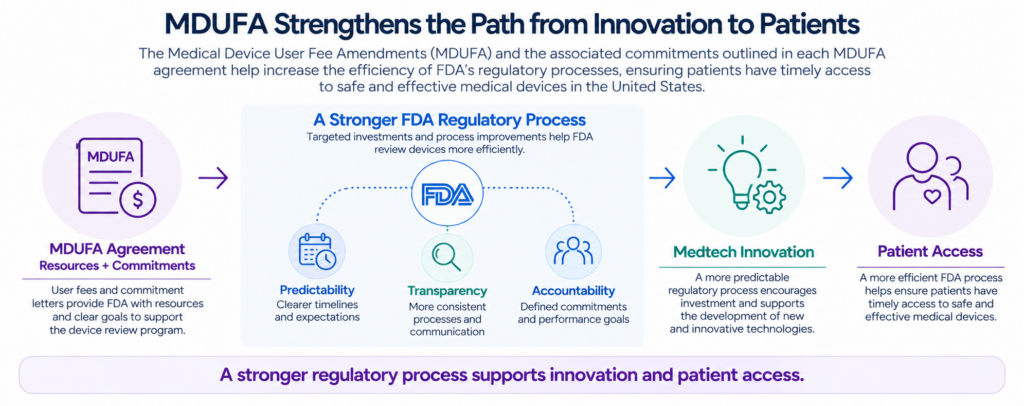
The Medical Device User Fee Amendments (MDUFA) and the associated commitments outlined in each MDUFA agreement commitment letter help increase the efficiency of FDA’s regulatory processes, ensuring patients have timely access to safe and effective medical devices in the United States. In addition to serving patients, the agreement promotes medtech innovation by implementing targeted improvements and resource investments that improve regulatory predictability, transparency, and FDA accountability
Why This Matters
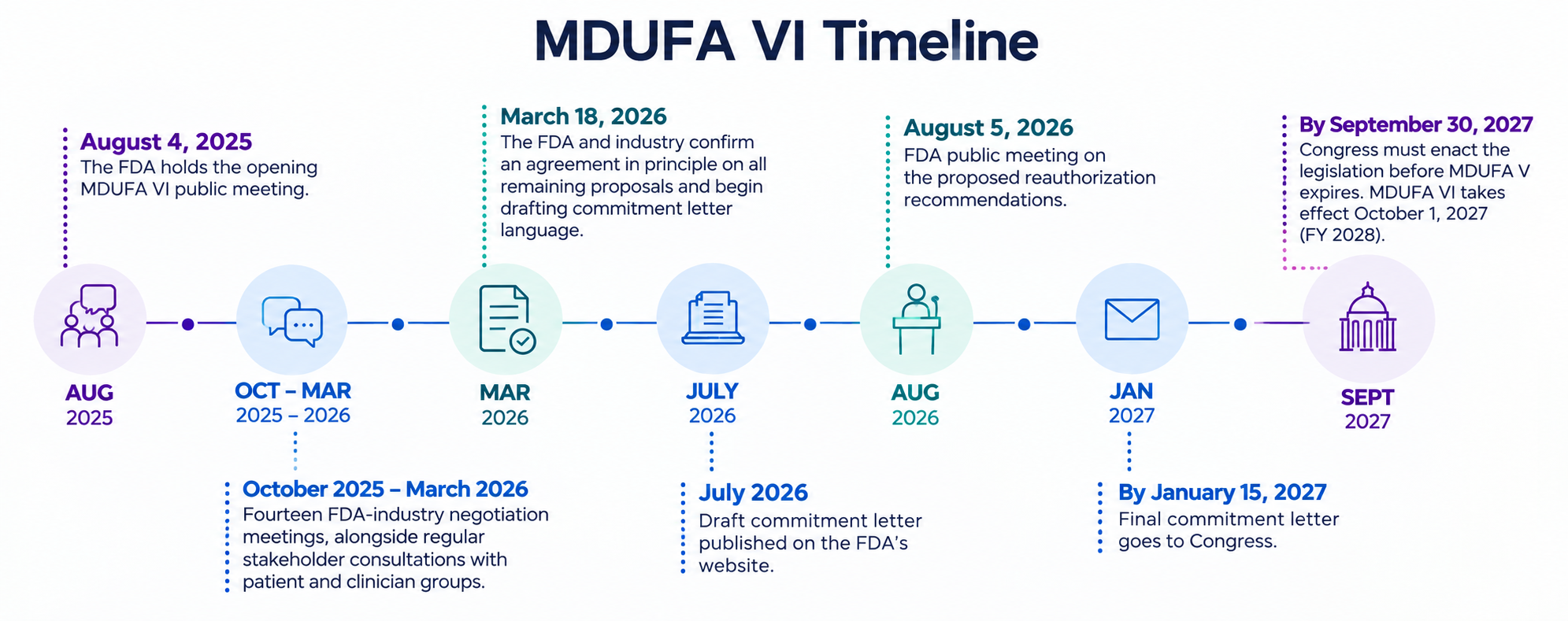
Each MDUFA agreement is negotiated by FDA, the medtech industry, and other stakeholders. Congress receives the draft agreement and must consider and pass legislation authorizing it and send the legislation to the President for signing into law. Each agreement sustains the program for five years. The current agreement, MDUFA V, expires September 30, 2027.

Fact Sheet
Medical Device User Fee Amendments FY2028-2032 (MDUFA VI)
The official FDA overview of the proposed MDUFA VI agreement, including user fees, review goals, and regulatory program enhancements.
Frequently Asked Questions
What is MDUFA and why does it matter?
MDUFA stands for the Medical Device User Fee Amendments. MDUFA agreements between the FDA and the medical device industry fund FDA’s device review program. Under MDUFA, companies pay user fees to the FDA in exchange for performance commitments on review timelines.
What is MDUFA VI and when does it take effect?
MDUFA VI is the sixth reauthorization of the Medical Device User Fee program, covering FY2028-2032. It establishes new user fee structures, FDA performance goals, and operational improvements for the medical device review process.
How does MDUFA affect how quickly patients can access new medical devices?
MDUFA directly funds FDA reviewer capacity and sets binding review timelines. When MDUFA goals are met, devices move through the approval process faster — getting life-saving innovations to patients more quickly.
What are FDA performance goals under MDUFA?
Performance goals are negotiated benchmarks that define how quickly FDA must act on device submissions — including 510(k) clearances, PMA approvals, De Novo requests, and breakthrough device reviews. Missing goals can trigger consequences under the MDUFA framework.
What improvements does MDUFA VI introduce compared to MDUFA V?
MDUFA VI introduces enhanced review timelines for novel devices, strengthened accountability mechanisms for FDA, investments in digital health and AI review capacity, and commitments to more collaborative pre-submission interactions.
AdvaMed’s Priority Policies
Strengthen Early FDA Engagement and Regulatory Predictability
- Supports: The creation of the “Focused Follow-up” Pre-Submission with faster response timelines.
- Why It Matters: Early engagement through the Pre-Submission program helps manufacturers understand FDA expectations before making significant development investments. Faster feedback and greater consistency reduce uncertainty, improve submission quality, and help companies bring innovative products to patients more efficiently.
- How MDUFA VI Helps: The MDUFA VI draft commitment letter creates a new “Focused Follow-Up” pre-submission pathway that provides written FDA feedback on targeted questions within approximately 45 days (~25 days faster than Traditional Pre-Submissions).
Promote Standards
- Supports: Use of consensus standards to promote more efficient, predictable reviews.
- Why It Matters: As an important tool for FDA and industry, use of recognized standards helps support the development of safe and effective medical devices and promotes consistency, reduces uncertainty, and aids reviewers and developers alike.
- How MDUFA VI Helps: Promotes greater recognition and use of consensus standards and supports additional training that can support the medical device review process.
International Harmonization
- Supports: Commitments to advance international harmonization efforts.
- Why It Matters: FDA leadership in advancing globally recognized regulatory approaches helps reduce duplicative regulatory requirements, assists U.S. manufacturers to help bring medical technology to patients, and advances U.S. interests in the global medical device space.
- How MDUFA VI Helps: MDUFA VI strengthens U.S. global leadership in device regulation through supporting FDA’s work within the International Medical Device Regulators Forum (IMDRF) along with bilateral reliance efforts and multi-lateral pilot projects and advancing the development of common submission forms.
Improve Efficiency & Transparency of the De Novo Pathway
- Supports: The creation of the “Introduction Meeting” and new templates for De Novo Pre-Submissions.
- Why It Matters: The De Novo pathway is critical for novel technologies. Effective communication and greater transparency during both the Pre-Submission phase and the De Novo review are essential to reduce unnecessary delays and ensure the submitter and FDA share a mutual understanding of expectations. A more predictable De Novo review can enhance investment in first-of-a-kind medical technologies and promote patient access to innovative devices.
- How MDUFA VI Helps: The “Introduction Meeting”, which occurs within the first 30 days of the De Novo review, ensures the submitter and FDA review team have an opportunity to discuss critical elements of the submission early in the review. The creation of new De Novo-specific Pre-Submission templates will help promote more effective communications regarding clinical study design.
Advancing the Use of Real-world Evidence (RWE)
- Supports: Commitments to advance regulatory acceptance of real-world data (RWD) and RWE for premarket submissions and the use of the NEST Mark in support of such submissions.
- Why It Matters: MDUFA VI commits FDA to advancing the use of RWD and RWE in premarket decision-making, including for expanded indications for use, market authorization of new devices, and market authorization of modifications or new features for market authorized devices, which help make new technologies and additional uses of existing devices available to patients sooner.
- How MDUFA VI Helps: MDUFA VI commits user fee funding to the continued development of RWD and RWE methods and policies to advance regulatory acceptance for premarket submissions. It also commits FDA, in collaboration with NEST, to update stakeholders on how the NEST Mark can be used to support premarket submissions, strengthens FDA reviewer training on RWD and RWE, and increases transparency and reporting on market authorizations that relied on RWE.
Leadership in AI and Emerging Technologies in Medtech
- Supports: Investments in digital health review modernization to better support emerging technologies such as artificial intelligence-enabled devices.
- Why It Matters: FDA has authorized a high number of AI-enabled medical devices, serving patients and doctors with the latest transformative diagnostic and treatment tools. Keeping pace with this pipeline requires FDA to hire, train and retain specialized experts, who are largely funded through MDUFA.
- How MDUFA VI Helps: The MDUFA VI commitments help enhance FDA’s digital-health expertise, engage with stakeholders on emerging technologies such as generative and agentic AI, and provide greater clarity about evidentiary expectations for novel technologies.
MDUFA V: The Foundation for Progress
Before MDUFA VI, MDUFA V helped advance predictable reviews, regulatory efficiency, and patient access to innovative medical technology.